Choosing the right abrasive media for sandblasting can make a significant difference in the blasting process. Different abrasive materials offer different levels of cutting power, cleaning performance, and surface finishing.
Therefore, you should consider several factors before selecting an abrasive. These factors include the material, surface condition, desired finish, grit size, and blasting equipment.
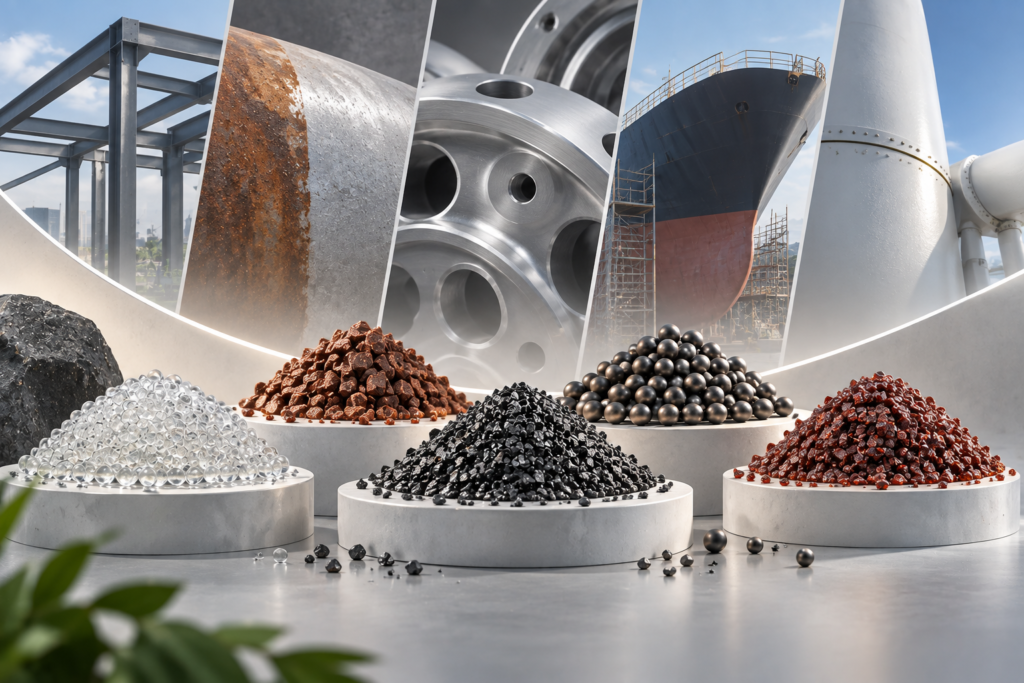
In this guide, we will explain how to choose the right abrasive for different applications. We will also compare Glass Beads, Aluminum Oxide, Garnet, Steel Grit, and Steel Shot.
What Is Abrasive Media?
Abrasive media is a material used to clean and prepare surfaces through abrasive blasting. The blasting equipment directs the media toward the surface at high speed.
As a result, the abrasive can remove rust, paint, coating, mill scale, dirt, and other contaminants.
However, each abrasive has different characteristics. The right choice depends on the material and the purpose of the blasting process.
Factors to Consider When Choosing Abrasive Media
Several factors can affect your abrasive selection. First, you need to understand the material and surface condition.
1. Material Type
Start by identifying the material that needs blasting. Common materials include steel, stainless steel, aluminum, and other metals.
For example, steel surfaces can often handle stronger abrasive media. Softer materials may require a more controlled blasting process.
Therefore, always check the material before selecting an abrasive.
2. Surface Condition
Next, inspect the surface carefully. Look for rust, paint, coating, mill scale, or other contamination.
For instance, light contamination may only require moderate cleaning power. Heavy rust and thick coating may need stronger cutting action.
Because of this, the surface condition should guide your abrasive selection.
3. Desired Surface Finish
The desired surface finish is another important factor. Some abrasives provide stronger cutting action, while others create a smoother finish.
For example, Glass Beads can provide a smoother appearance for cleaning and finishing applications.
In contrast, Steel Grit offers stronger cutting action for heavy cleaning and coating removal.
As a result, define your desired surface finish before choosing the abrasive.
4. Abrasive Hardness
Abrasive hardness affects blasting performance. Harder abrasive materials can provide stronger cutting action.
However, the hardest abrasive is not always the most suitable option. The media should match the material and the purpose of the project.
For this reason, consider both abrasive hardness and surface requirements.
5. Grit Size
Grit size also affects the blasting result. Coarse grit can remove material more aggressively.
Meanwhile, finer grit can provide more control during certain applications.
Therefore, select the grit size according to the surface condition and desired result.
Common Types of Abrasive Media
Different applications require different abrasive materials. Next, let’s look at several common options.
Glass Beads
Glass Beads have a round particle shape. This shape creates a relatively gentle blasting action.
In addition, Glass Beads can help clean metal surfaces while producing a smoother and more uniform appearance.
Common applications include:
- Stainless steel cleaning
- Aluminum cleaning
- Surface finishing
- Light contamination removal
- Cosmetic finishing
Therefore, Glass Beads can be suitable when cleaning and appearance are important.
Aluminum Oxide
Aluminum Oxide is a hard abrasive with sharp particles. Its particle shape provides strong cutting performance.
For example, this abrasive can help remove rust, old paint, and coating from metal surfaces.
Typical applications include:
- Rust removal
- Paint removal
- Coating removal
- Surface preparation
- Preparation before painting
As a result, Aluminum Oxide can work well for demanding surface preparation.
Garnet
Garnet is a mineral-based abrasive used for cleaning and surface preparation.
In addition, this abrasive can help remove rust, paint, coating, mill scale, and surface contamination.
Typical applications include:
- Rust removal
- Paint removal
- Surface cleaning
- Surface preparation
- Preparation before coating
For this reason, Garnet can be considered for various industrial blasting applications.
Steel Grit
Steel Grit has an angular particle shape with sharp edges. These edges create strong cutting action during blasting.
Furthermore, Steel Grit can help remove heavy rust, paint, coating, and mill scale.
Typical applications include:
- Heavy rust removal
- Paint removal
- Coating removal
- Mill scale removal
- Steel surface preparation
Therefore, Steel Grit can suit applications that require strong cutting performance.
Steel Shot
Steel Shot has a round or spherical particle shape. This shape produces a consistent impact on the surface.
Meanwhile, Steel Shot is commonly used for cleaning and certain surface treatment applications.
Typical applications include:
- Metal cleaning
- Scale removal
- Surface treatment
- Industrial applications
- Shot peening
In contrast, Steel Grit has an angular shape and provides stronger cutting action.
Abrasive Media Comparison
| Abrasive Media | Shape | Main Characteristic | Common Application |
|---|---|---|---|
| Glass Beads | Round | Gentle blasting | Cleaning and finishing |
| Aluminum Oxide | Angular | High cutting power | Surface preparation |
| Garnet | Angular | Mineral abrasive | Cleaning and preparation |
| Steel Grit | Angular | Strong cutting action | Rust and coating removal |
| Steel Shot | Round | Consistent impact | Cleaning and surface treatment |
Overall, each abrasive has a different purpose. The final selection should match the material, surface condition, equipment, and desired result.
How to Select the Right Abrasive
You can follow a simple process when choosing abrasive media.
Step 1: Identify the Material
First, determine the type of material that you want to blast. Check whether it is steel, stainless steel, aluminum, or another material.
Step 2: Check the Surface
Next, inspect the surface condition. Identify rust, paint, coating, mill scale, or other contaminants.
Step 3: Define the Goal
After that, determine the main purpose of the blasting process.
You may need cleaning, rust removal, coating removal, or surface preparation.
Step 4: Choose the Abrasive
Then, select an abrasive that matches your application.
Glass Beads can work well for cleaning and finishing. On the other hand, Aluminum Oxide and Steel Grit can provide stronger cutting action.
Garnet offers another option for cleaning and surface preparation. Meanwhile, Steel Shot provides consistent impact for suitable cleaning and treatment applications.
Step 5: Select the Grit Size
Finally, choose a suitable grit size. Consider the surface condition, desired result, and blasting equipment.
If you are unsure, consult an abrasive specialist before starting the project.
Why Is Abrasive Selection Important?
The right abrasive can improve the efficiency and consistency of the blasting process.
In addition, proper abrasive selection can help you achieve the required surface condition before painting or coating.
On the other hand, an unsuitable abrasive may create an unwanted surface profile or increase blasting time.
For this reason, always evaluate the material, surface condition, abrasive type, grit size, equipment, and desired result.
Need Abrasive Media for Your Project?
PURFEQU provides different types of abrasive media for sandblasting, including Glass Beads, Aluminum Oxide, Garnet, Steel Grit, and Steel Shot.
Furthermore, each product has different characteristics and applications.
Therefore, choosing the right product should start with your project requirements.
If you need help selecting an abrasive, contact the PURFEQU team. Simply provide information about the material, surface condition, and blasting application.
Finally, our team can help you identify a suitable abrasive for your project.
Contact PURFEQU
Looking for the right abrasive media for sandblasting?
Contact PURFEQU today to discuss your sandblasting requirements.