
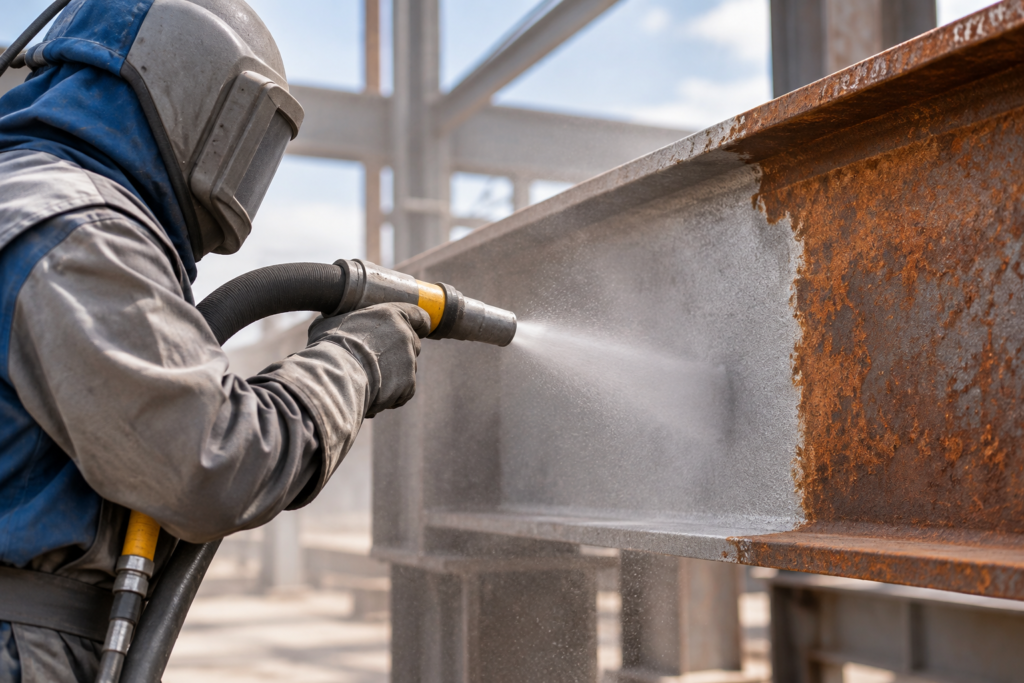
Consistent abrasive blasting results help create a clean and uniform surface before painting, coating, or other surface treatments.
However, many factors can change the final blasting result. These factors include abrasive quality, air pressure, nozzle condition, blasting distance, abrasive flow, and operator technique.
Therefore, operators need to control these factors throughout the blasting process.
In this article, we will explain how to maintain consistent abrasive blasting results and improve overall blasting performance.
Read More : How to Choose the Right Abrasive Media for Sandblasting
Why Are Consistent Abrasive Blasting Results Important?
Abrasive blasting removes rust, paint, scale, corrosion, and other surface contaminants.
In addition, blasting can create a specific surface profile. This profile can affect coating adhesion and overall coating performance.
However, an inconsistent blasting process can create different surface conditions across the same workpiece.
For example, one area may receive enough blasting while another area may still contain rust or old coating.
As a result, the coating may not perform consistently across the entire surface.
Consistent blasting can help achieve:
- Uniform surface cleanliness
- More consistent surface profiles
- Better coating preparation
- More predictable abrasive consumption
- Better blasting efficiency
- More consistent production results
1. Choose the Right Abrasive Media
First, choose an abrasive that matches the application.
Different abrasive media have different shapes, hardness levels, and cutting characteristics.
For example, angular abrasives can provide strong cutting action. On the other hand, spherical abrasives can create a different impact pattern and surface finish.
Common abrasive media include:
- Aluminium Oxide
- Garnet
- Glass Beads
- Steel Grit
- Steel Shot
Therefore, consider the substrate, surface contamination, required profile, and desired finish before selecting an abrasive.
Do not choose abrasive media based only on price. Instead, consider the complete blasting requirement.
2. Keep Abrasive Quality Consistent
Next, check the condition of the abrasive media regularly.
During blasting, abrasive particles can break down or become contaminated. Moisture and foreign materials can also affect abrasive performance.
For this reason, inspect the abrasive before and during use.
Check for:
- Moisture
- Foreign materials
- Contamination
- Broken-down particles
- Changes in abrasive flow
In addition, store abrasive media in a clean and dry area.
As a result, the abrasive can maintain more predictable performance during blasting.
3. Maintain Stable Air Pressure
Air pressure directly affects abrasive blasting performance.
For example, higher pressure can increase abrasive impact. However, the correct pressure depends on the abrasive, substrate, equipment, and application.
Therefore, avoid making unnecessary pressure changes during the blasting process.
Instead, maintain a stable working pressure that matches the equipment and application.
Also, check the compressor and air supply regularly.
A stable air supply helps operators maintain more consistent blasting performance.
4. Check the Sandblasting Nozzle
The nozzle also plays an important role in abrasive blasting results.
Over time, abrasive particles can wear the inside of the nozzle. As the nozzle wears, the blasting performance can change.
Therefore, operators should inspect the nozzle regularly.
Check for:
- Internal wear
- Uneven nozzle openings
- Cracks
- Physical damage
- Changes in blasting performance
If the nozzle shows excessive wear, replace it according to the equipment manufacturer’s recommendations.
As a result, the blasting system can maintain more consistent performance.
5. Maintain a Consistent Blasting Distance
The distance between the nozzle and the surface can change the blasting result.
If the operator moves the nozzle too close, the abrasive can create a stronger impact on the surface.
In contrast, excessive distance can reduce abrasive impact and cleaning efficiency.
Therefore, maintain a consistent working distance whenever possible.
Furthermore, train operators to use the same technique throughout the blasting process.
This approach can help create a more uniform surface.
6. Keep the Nozzle Angle Consistent
The nozzle angle also affects abrasive impact.
For example, changing the angle during blasting can change how abrasive particles interact with the surface.
Therefore, operators should maintain a controlled nozzle angle during the process.
However, the ideal angle can vary depending on the abrasive, substrate, and application.
For this reason, always follow the recommended blasting procedure for the specific job.
7. Control Abrasive Flow
Abrasive flow also affects blasting efficiency.
Too little abrasive can reduce productivity. Meanwhile, excessive abrasive flow may not always improve cleaning performance.
In addition, excessive abrasive flow can affect air velocity and overall system efficiency.
Therefore, adjust the abrasive flow according to the blasting equipment and application.
A stable abrasive flow helps create more predictable blasting results.
8. Prepare the Surface Properly
The initial surface condition can also affect abrasive blasting results.
For example, thick rust, old coatings, mill scale, and heavy contamination may require different blasting conditions.
Therefore, inspect the surface before starting the blasting process.
Identify the type and condition of the contamination first.
Then, select the appropriate abrasive and blasting parameters.
As a result, operators can achieve better and more consistent results.
9. Use a Standard Blasting Procedure
A standard procedure can reduce variations between operators.
First, inspect the surface.
Next, select the appropriate abrasive media.
Then, check the blasting equipment and nozzle condition.
After that, set the working pressure and abrasive flow.
During blasting, maintain a consistent distance and nozzle angle.
Finally, inspect the surface after blasting.
A standard procedure helps operators follow the same process for similar applications.
10. Inspect the Surface After Blasting
Finally, inspect the surface after blasting.
Visual inspection can help identify areas that need additional blasting.
However, visual inspection alone may not always provide enough information.
For projects with specific coating requirements, operators may also need to check surface cleanliness and surface profile with appropriate inspection methods.
Therefore, include surface inspection as part of the blasting process.
This step can help identify problems before the coating process begins.
Common Causes of Inconsistent Abrasive Blasting Results
If blasting results vary from one area to another, check the following factors:
| Problem | Possible Cause |
|---|---|
| Uneven surface | Inconsistent nozzle movement |
| Poor cleaning | Low pressure or unsuitable abrasive |
| High abrasive consumption | Excessive abrasive flow or worn equipment |
| Different surface profile | Changes in abrasive, pressure, or technique |
| Reduced blasting performance | Worn nozzle or contaminated abrasive |
| Inconsistent finish | Different blasting distance or nozzle angle |
Therefore, identify the cause before changing multiple blasting parameters at the same time.
This approach makes troubleshooting easier and more systematic.
How to Improve Abrasive Blasting Consistency
To improve consistency, control several factors together.
Abrasive
- Choose the correct abrasive type.
- Keep abrasive media clean and dry.
- Check abrasive condition regularly.
Equipment
- Maintain stable air pressure.
- Inspect the nozzle regularly.
- Check hoses and blasting equipment.
Operator
- Maintain a consistent blasting distance.
- Keep the nozzle angle controlled.
- Use consistent nozzle movement.
Surface
- Inspect the substrate before blasting.
- Identify surface contamination.
- Check the final surface after blasting.
In addition, record important blasting parameters for repeat jobs.
For example, record the abrasive type, nozzle size, air pressure, and general blasting procedure.
This information can help your team reproduce similar results in future projects.
Choose the Right Abrasive for Your Application
The abrasive media has an important role in the blasting process.
For example, Glass Beads can suit applications that require cleaning and finishing. Meanwhile, Aluminium Oxide can provide stronger cutting action for surface preparation.
Similarly, Garnet, Steel Grit, and Steel Shot have different characteristics and applications.
Therefore, always match the abrasive with the substrate and required surface condition.
If you are unsure which abrasive suits your application, contact PURFEQU for technical guidance.
Conclusion
Consistent abrasive blasting results require control over several factors.
First, choose the right abrasive media for the application. Next, maintain stable air pressure and abrasive flow.
In addition, check the nozzle condition regularly. Keep the blasting distance and nozzle angle consistent as well.
Finally, inspect the surface after blasting.
By controlling these factors, your team can improve blasting consistency, reduce unnecessary rework, and achieve more predictable surface preparation results.
Need help choosing the right abrasive media? Contact PURFEQU for abrasive media and technical solutions for your blasting application.
FAQ
What affects abrasive blasting results?
Several factors can affect abrasive blasting results. These include abrasive type, abrasive condition, air pressure, nozzle condition, blasting distance, nozzle angle, abrasive flow, and surface condition.
How can I make sandblasting results more consistent?
First, choose the correct abrasive. Then, maintain stable air pressure and abrasive flow. Also, keep the blasting distance and nozzle angle consistent.
Does nozzle wear affect abrasive blasting?
Yes. A worn nozzle can change abrasive velocity and blasting performance. Therefore, regular nozzle inspection can help maintain consistent results.
Why does abrasive quality matter?
Clean and dry abrasive media can provide more predictable blasting performance. In contrast, moisture, contamination, and particle breakdown can affect the blasting process.
Can the same abrasive produce different results?
Yes. Even when you use the same abrasive, changes in pressure, nozzle condition, abrasive flow, and operator technique can produce different results.