
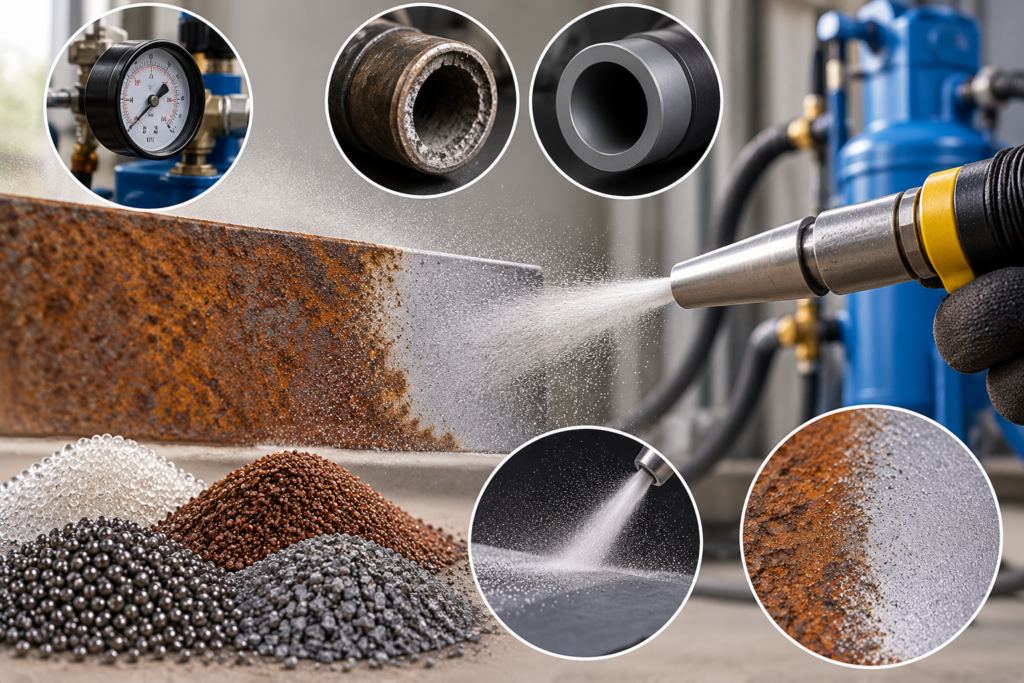
Abrasive consumption is an important factor in sandblasting efficiency. Using too much abrasive media can increase operating costs without necessarily improving the blasting result.
Many factors can affect abrasive consumption, including blasting pressure, nozzle condition, abrasive type, surface condition, and blasting technique.
Understanding these factors can help operators reduce media waste while maintaining consistent surface preparation results.
What Is Abrasive Consumption?
Abrasive consumption refers to the amount of abrasive media used during a blasting process.
The actual consumption can vary depending on the application. A light cleaning job may require much less abrasive than heavy rust removal or surface preparation.
For industrial blasting, controlling abrasive consumption is important because abrasive media can become a significant part of operating costs.
However, using less media is not always the goal. The main objective is to achieve the required surface condition with an efficient combination of abrasive media, pressure, nozzle, and blasting technique.
What Makes Sandblasting Use More Abrasive Media?
Several factors can increase abrasive consumption. Here are the most common ones.
1. Excessive Blasting Pressure
Higher pressure can increase the velocity of abrasive particles. This can improve cleaning performance in some applications, but excessive pressure may also increase media consumption.
The correct pressure depends on the abrasive, surface material, nozzle, and required surface profile.
Instead of simply increasing pressure, operators should adjust the blasting parameters according to the application.
2. Worn Sandblasting Nozzle
A worn nozzle is one of the factors that can significantly affect abrasive consumption.
As the nozzle bore wears, its internal diameter can become larger. This can increase abrasive flow and change the blasting performance.
As a result, an old nozzle may consume more abrasive while providing less efficient blasting.
Regularly checking the condition of the sandblasting nozzle can help prevent unnecessary media consumption.
3. Incorrect Abrasive Media
Different surfaces require different abrasive characteristics.
Using an abrasive that is too aggressive may remove material faster than necessary. On the other hand, using a media that is too mild can require longer blasting time.
Both situations can increase abrasive consumption.
The abrasive should be selected based on:
- Surface material
- Type of contamination
- Required surface profile
- Desired finishing
- Blasting equipment
- Reusability of the abrasive
Choosing the right sandblasting media can improve both productivity and abrasive efficiency.
4. Incorrect Abrasive Flow
Abrasive flow needs to match the available air pressure and blasting equipment.
Too much abrasive can reduce blasting efficiency because the air stream may not accelerate the particles effectively.
Instead of assuming that more abrasive means faster cleaning, operators should find a balanced abrasive flow for the equipment being used.
5. Nozzle Distance and Blasting Angle
The distance between the nozzle and the workpiece also affects blasting efficiency.
Holding the nozzle too far away can reduce the impact of the abrasive. This may force the operator to spend more time on the same area.
The blasting angle also affects how efficiently contamination is removed.
Maintaining a suitable nozzle distance and blasting angle can help achieve better coverage without unnecessarily increasing abrasive consumption.
6. Heavy Rust, Paint, or Contamination
The condition of the surface directly affects abrasive usage.
A heavily corroded or coated surface naturally requires more work than a lightly contaminated surface.
For example, removing thick layers of old coating may require more abrasive and more blasting time than removing light surface oxidation.
This is why abrasive consumption should always be evaluated based on the actual condition of the workpiece.
7. Inefficient Blasting Technique
Operator technique can also influence abrasive consumption.
Repeatedly blasting the same area, moving the nozzle too slowly, or using inconsistent movements can increase media usage.
A controlled and consistent blasting motion helps distribute abrasive more efficiently across the surface.
How to Reduce Abrasive Consumption
Reducing abrasive consumption does not simply mean using less media. The goal is to use abrasive efficiently while achieving the required surface preparation result.
Here are several practical steps.
Choose the Right Abrasive
Select the abrasive based on the surface and the required result.
For example, glass beads, garnet, aluminium oxide, steel grit, and steel shot have different characteristics and applications.
Using the correct media can reduce unnecessary blasting time.
Check the Nozzle Regularly
Inspect the nozzle for signs of wear.
A worn nozzle can affect abrasive flow and increase consumption. Replacing the nozzle when necessary can help maintain more predictable blasting performance.
Adjust Pressure and Abrasive Flow
Do not automatically use the highest possible pressure.
Test the combination of pressure and abrasive flow to find an efficient setting for the specific application.
This can help balance:
Cleaning speed + surface quality + abrasive consumption
Maintain a Consistent Blasting Technique
Keep the nozzle movement controlled and consistent.
Avoid staying too long in one area unless additional cleaning is required.
Consistent technique can improve coverage and reduce unnecessary abrasive usage.
Consider Abrasive Reusability
Some abrasive media can be reused depending on the blasting system, material, contamination level, and media durability.
For applications where abrasive recovery is possible, reusable media can help reduce overall media consumption.
Does Higher Abrasive Consumption Always Mean Better Results?
No.
Using more abrasive does not automatically produce better surface preparation.
The final result depends on several variables, including:
- Abrasive type
- Particle size
- Air pressure
- Abrasive flow
- Nozzle condition
- Nozzle distance
- Blasting angle
- Surface condition
- Operator technique
A well-adjusted blasting process can achieve the required result without unnecessarily increasing abrasive consumption.
How Nozzle Condition Affects Abrasive Consumption
The nozzle deserves special attention because it directly affects the abrasive stream.
As a nozzle wears, the increased bore size can change the amount of abrasive passing through the system.
This can lead to higher abrasive consumption and may also affect blasting productivity.
For this reason, checking nozzle condition should be part of regular blasting equipment maintenance.
How to Improve Sandblasting Efficiency
An efficient sandblasting process requires the different components to work together.
The abrasive media, blasting gun, nozzle, air pressure, abrasive flow, and operator technique should be properly matched.
Instead of focusing on one variable, evaluate the complete blasting setup.
A useful approach is to monitor:
Abrasive used → Area blasted → Blasting time → Surface result
This makes it easier to identify whether excessive abrasive consumption is caused by the media, equipment, or blasting process.
Conclusion
Abrasive consumption in sandblasting is influenced by much more than the amount of media used.
Excessive pressure, worn nozzles, incorrect abrasive flow, unsuitable media, poor nozzle positioning, heavy surface contamination, and inefficient blasting techniques can all increase media consumption.
By selecting the right sandblasting media, maintaining the nozzle, adjusting blasting parameters, and using a consistent technique, operators can improve blasting efficiency while controlling abrasive usage.
The goal is not simply to use less abrasive. The goal is to achieve the required surface preparation with the right amount of abrasive and the most efficient blasting process.
FAQ
What causes high abrasive consumption in sandblasting?
High abrasive consumption can be caused by excessive pressure, worn nozzles, incorrect abrasive flow, unsuitable media, poor blasting technique, and heavily contaminated surfaces.
Does a worn nozzle increase abrasive consumption?
Yes. As a nozzle wears, its bore can become larger, which can increase abrasive flow and affect overall blasting efficiency.
How can I reduce sandblasting media consumption?
Choose the appropriate abrasive, maintain the nozzle, optimize pressure and abrasive flow, maintain the correct nozzle distance, and use a consistent blasting technique.
Does higher pressure always reduce blasting time?
Not necessarily. Higher pressure can increase particle velocity, but excessive pressure may increase abrasive consumption and may not be suitable for every surface or abrasive.
What is the best abrasive for reducing consumption?
There is no single best abrasive for every application. The appropriate media depends on the workpiece material, contamination, required surface profile, equipment, and desired result.