
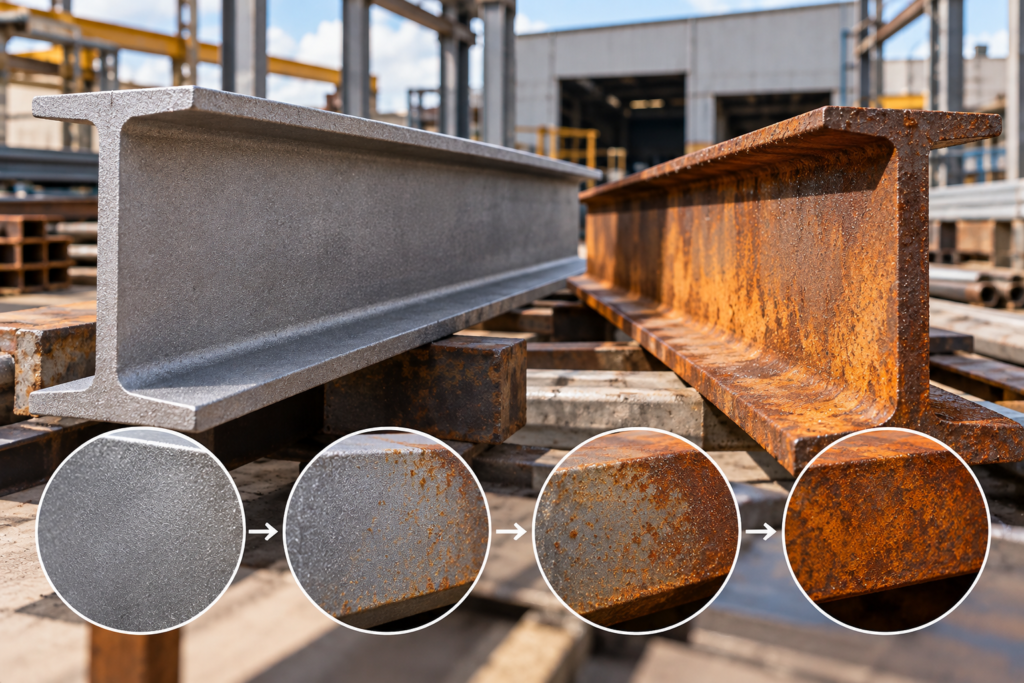
Sandblasting creates a clean surface that is ready for painting, coating, or other surface treatments. However, freshly blasted steel does not stay in the same condition indefinitely.
Once the surface is exposed to air and moisture, oxidation can begin again. This can lead to flash rust, which appears as a yellow, orange, or brown discoloration on the freshly prepared steel.
So, how long can sandblasted steel stay uncoated?
There is no universal time limit. The allowable time depends on humidity, temperature, surface cleanliness, storage conditions, and the required coating system.
In humid or coastal environments, oxidation can develop much faster than in a dry, controlled environment.
Why Does Sandblasted Steel Rust Again?
During abrasive blasting, rust, old coatings, scale, and other contaminants are removed from the steel surface.
The process also exposes fresh metal.
Freshly prepared steel can react with moisture and oxygen in the surrounding environment. If enough moisture is present, oxidation can begin soon after blasting.
This is why coating should generally be applied as soon as practical after surface preparation.
The longer the steel remains exposed, the greater the risk of surface contamination and flash rust.
What Is Flash Rust?
Flash rust is a thin layer of corrosion that can develop on freshly cleaned steel.
It can appear as:
- Light yellow discoloration
- Orange staining
- Brown surface rust
- Uneven patches across the steel
Flash rust can develop even when the steel looked completely clean immediately after blasting.
This does not necessarily mean the blasting process was unsuccessful. It can simply indicate that the prepared surface was exposed to moisture before coating.
How Quickly Can Flash Rust Appear?
Flash rust does not occur at exactly the same rate in every situation.
Several environmental factors influence how quickly it develops.
Humidity
High relative humidity increases the availability of moisture around the steel surface.
As humidity rises, the risk of oxidation generally increases.
This is particularly important in tropical, coastal, or poorly ventilated environments.
Temperature
Temperature affects both the steel surface and the surrounding air.
If the steel surface becomes colder than the surrounding air, condensation can form.
Even a small amount of moisture can become a problem for freshly blasted steel.
Surface Condition
The condition of the steel after blasting also matters.
A clean and properly prepared surface can still oxidize when exposed to moisture. Contamination, dust, salts, or residues can further complicate the coating process.
Storage Environment
Where the blasted steel is stored can make a significant difference.
Steel stored in a dry and controlled environment has different exposure conditions from steel left outdoors.
Rain, condensation, humidity, and airborne contaminants can accelerate surface deterioration.
Read More : How to Keep Abrasive Blasting Results Consistent
Can Sandblasted Steel Be Left Overnight?
Sometimes, yes. But it should not be treated as a universal rule.
Whether freshly blasted steel can remain uncoated overnight depends on the environment and the coating specification.
For example, steel stored in a dry and controlled workshop may remain in good condition longer than steel exposed to humid outdoor air.
Before coating, the surface should always be inspected for:
- Flash rust
- Dust
- Oil
- Moisture
- Salt contamination
- Other visible contaminants
If the surface condition has changed significantly, additional preparation may be required before applying the coating.
What Happens If You Wait Too Long to Apply Coating?
Leaving blasted steel exposed for too long can create several problems.
1. Flash Rust Can Develop
The most obvious problem is new oxidation.
Even a thin layer of rust can affect the condition of the surface before coating.
2. The Surface Can Become Contaminated
Dust, oil, moisture, salts, and other airborne contaminants can settle on the prepared surface.
This can reduce coating performance.
3. Additional Surface Preparation May Be Required
If significant rust or contamination develops, the steel may need to be cleaned or blasted again before coating.
This adds:
- Labor
- Abrasive consumption
- Equipment time
- Production downtime
Therefore, coordinating blasting and coating schedules is important for industrial projects.
How to Protect Sandblasted Steel Before Coating
If coating cannot be applied immediately, proper storage and handling can help reduce the risk of surface deterioration.
1. Keep the Steel Dry
Protect freshly blasted steel from rain, condensation, and direct moisture.
Avoid leaving prepared steel exposed outdoors when weather conditions are unfavorable.
2. Control Humidity When Possible
A controlled environment can help slow down oxidation.
This is particularly useful for indoor blasting and coating operations.
3. Avoid Touching the Prepared Surface
Bare hands can transfer oil, sweat, and other contaminants to freshly prepared steel.
Use appropriate gloves and handling procedures.
4. Keep the Surface Clean
Prevent dust and other contaminants from settling on the blasted surface.
The cleaner the surface remains, the easier it is to proceed with coating preparation.
5. Coordinate Blasting and Coating
For production environments, it is often more efficient to schedule blasting close to the coating operation.
This reduces the amount of time the steel remains exposed.
Should You Reblast Steel That Has Developed Flash Rust?
Not always.
The required action depends on the degree of flash rust and the specification of the coating system.
Light surface discoloration may be treated differently from heavier corrosion.
Before coating, inspect the surface and compare its condition with the requirements of the coating manufacturer or project specification.
If the surface no longer meets the required preparation standard, additional cleaning or abrasive blasting may be necessary.
The important point is not to simply coat over a surface without checking its condition.
How Abrasive Blasting Affects Coating Performance
Abrasive blasting is commonly used to prepare steel before coating because it can remove contaminants and create a suitable surface profile.
However, good blasting alone does not guarantee a good coating result.
The complete process matters:
Surface preparation → Inspection → Cleaning → Coating
If the prepared steel becomes contaminated or develops significant oxidation before coating, the benefits of the original blasting process can be reduced.
This is why the period between blasting and coating should be managed carefully.
Does Abrasive Media Affect the Prepared Surface?
Yes.
Different abrasive media produce different surface characteristics.
Factors such as:
- Particle size
- Particle shape
- Abrasive hardness
- Blasting pressure
- Nozzle condition
- Blasting technique
can influence the resulting surface profile.
For this reason, abrasive selection should be based on the material and the required coating system.
Common abrasive media include garnet, aluminium oxide, steel grit, steel shot, and glass beads, although their applications and resulting surface characteristics differ.
Read More : How to Choose the Right Abrasive Media for Sandblasting
Best Practice for Sandblasted Steel
There is no single number of hours that applies to every sandblasted steel surface.
Instead, consider the actual environment and coating requirements.
A practical workflow is:
1. Blast the steel
Remove rust, scale, old coating, and other contaminants.
2. Inspect the surface
Check cleanliness, surface profile, and visible contamination.
3. Protect the prepared surface
Keep the steel dry and protected from contamination.
4. Monitor environmental conditions
Pay attention to humidity, temperature, condensation, and weather.
5. Apply the coating as soon as practical
Avoid unnecessary delays between surface preparation and coating.
6. Inspect again before coating
Check for flash rust, dust, moisture, and other contamination.
This approach is more reliable than relying on a fixed number of hours.
Conclusion
So, how long can sandblasted steel stay uncoated?
The answer depends on the environment and the condition of the prepared surface. There is no universal time that guarantees freshly blasted steel will remain suitable for coating.
Humidity, condensation, temperature, contamination, storage conditions, and the required coating system can all affect the surface after blasting.
For the best coating performance, freshly sandblasted steel should be protected from moisture and contamination and coated as soon as practical.
If flash rust or contamination develops, inspect the surface before coating and perform additional surface preparation when required.
Good abrasive blasting is only the first step. Maintaining the prepared surface until coating is applied is equally important.
FAQ
How long can sandblasted steel stay uncoated?
There is no universal time limit. The acceptable period depends on humidity, temperature, condensation, contamination, storage conditions, and the coating specification.
Can sandblasted steel rust overnight?
Yes. Under humid or wet conditions, freshly blasted steel can develop flash rust relatively quickly. Dry and controlled environments can reduce the risk.
What causes flash rust after sandblasting?
Flash rust occurs when freshly prepared steel is exposed to moisture and oxygen. High humidity, condensation, rain, and poor storage conditions can increase the risk.
Should sandblasted steel be coated immediately?
Coating should generally be applied as soon as practical after surface preparation. The exact timing should follow the coating manufacturer’s requirements and the project specification.
Can you paint over flash rust?
It depends on the degree of flash rust and the requirements of the coating system. The surface should be inspected and prepared according to the coating manufacturer’s specifications before painting.