
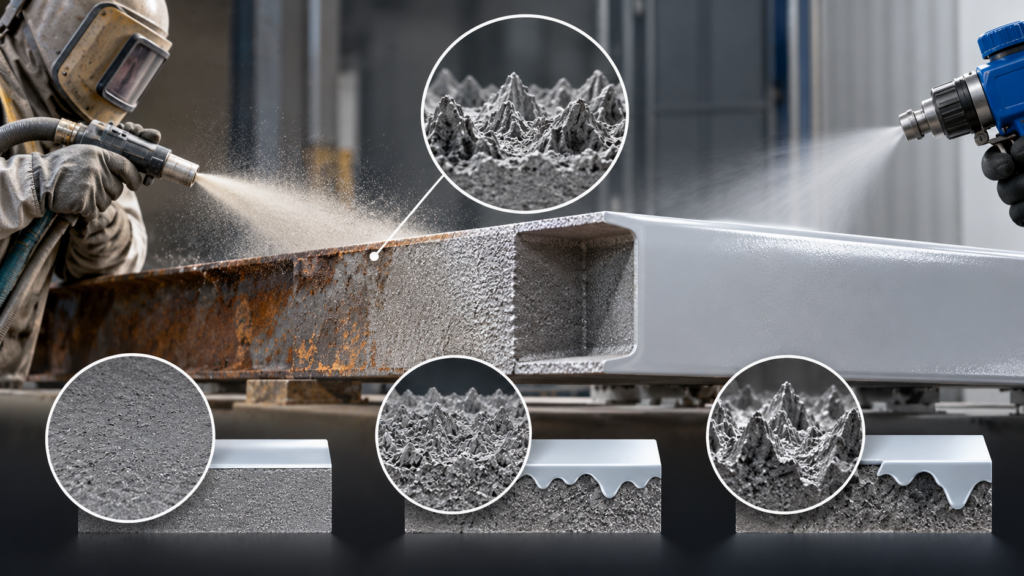
A surface can look clean after sandblasting, but that does not always mean it is ready for coating.
Before applying paint, powder coating, or another protective coating, one important factor needs to be considered: surface profile.
The surface profile created by abrasive blasting affects how well the coating can bond to the substrate. If the profile is not suitable for the coating system, problems such as poor adhesion, premature peeling, and corrosion can occur.
So, what exactly is a sandblasting surface profile, and why does it matter before coating?
What Is a Sandblasting Surface Profile?
A sandblasting surface profile is the microscopic roughness created on a material after abrasive blasting.
When abrasive particles hit the surface, they remove contaminants, rust, old coatings, and other unwanted materials. At the same time, the impact creates small peaks and valleys across the surface.
These peaks and valleys form the surface profile.
Unlike a smooth surface, a properly blasted surface provides a mechanical texture that can help the coating adhere more effectively.
Why Does Surface Profile Matter Before Coating?
The main reason is coating adhesion.
A coating needs enough surface texture to establish a strong bond with the substrate. If the surface is too smooth, the coating may not have enough mechanical grip.
However, making the surface as rough as possible is not the solution either.
An excessively rough profile can create other problems, including:
- Higher coating consumption
- Uneven coating thickness
- Poor coverage over surface peaks
- Increased risk of exposed peaks
- More difficult finishing
The goal is therefore not to create the roughest surface possible.
The goal is to create a surface profile that is appropriate for the coating system and substrate.
Read More : Abrasive Consumption: What Makes Sandblasting Use More Media?
What Happens If the Surface Profile Is Too Low?
When the profile is too shallow, the coating may have insufficient mechanical anchoring.
This can contribute to:
- Poor adhesion
- Peeling
- Flaking
- Premature coating failure
- Reduced coating durability
A surface can look visually clean while still having an unsuitable profile.
This is why visual cleanliness alone should not always be used to determine whether a surface is ready for coating.
What Happens If the Surface Profile Is Too High?
A profile that is excessively rough can also create problems.
The coating needs to cover the peaks and valleys of the blasted surface. If the peaks are too high compared with the coating thickness, some areas may receive insufficient protection.
It can also increase coating consumption because more material is required to cover the surface texture.
For industrial applications, controlling the profile can therefore help improve both coating performance and material efficiency.
What Affects Sandblasting Surface Profile?
Several factors influence the profile produced during abrasive blasting.
1. Abrasive Particle Size
Particle size has a significant effect on the resulting surface texture.
Coarser abrasive media can generally create a more aggressive surface profile, while finer media may produce a finer texture.
However, particle size should always be selected according to the substrate and coating requirements.
2. Abrasive Type
Different abrasive media have different characteristics.
For example:
- Glass Beads — generally suitable when a finer, more uniform finish is required.
- Aluminium Oxide — aggressive and commonly used for surface preparation.
- Garnet — useful for various cleaning and surface preparation applications.
- Steel Grit — commonly used when a more aggressive profile is required on suitable steel surfaces.
The right abrasive depends on the desired surface condition, substrate, and application.
3. Blast Pressure
Higher pressure can increase the impact energy of the abrasive particles.
However, simply increasing pressure is not always the best way to create a better profile.
Excessive pressure can unnecessarily damage the substrate, increase abrasive consumption, or create a profile that is too aggressive.
4. Blast Distance and Angle
The distance between the nozzle and surface also affects blasting performance.
The blasting angle can influence how abrasive particles impact the substrate and how effectively contaminants are removed.
Therefore, maintaining consistent blasting parameters is important when a controlled surface profile is required.
5. Nozzle Condition
A worn nozzle can change blasting performance.
As the nozzle wears, the blasting system can lose efficiency and consume more abrasive or compressed air.
For consistent results, nozzle condition should be checked regularly.
How Is Surface Profile Measured?
Surface profile should not be judged only by looking at the surface.
Depending on the application, surface profile can be evaluated using appropriate measurement methods and instruments.
Common approaches include:
- Replica tape
- Surface profile gauges
- Comparator methods
- Digital surface roughness instruments
The appropriate method depends on the specification and project requirements.
For industrial coating work, always follow the relevant project specification or coating manufacturer’s requirements.
Surface Cleanliness vs Surface Profile
These two concepts are related, but they are not the same thing.
Surface cleanliness refers to the removal of contaminants such as:
- Rust
- Mill scale
- Old coating
- Dirt
- Oil
- Other contaminants
Surface profile refers to the texture or roughness created on the substrate by abrasive blasting.
A surface can therefore be:
Clean but have an unsuitable surface profile.
This distinction is important because achieving a visually clean surface does not automatically mean the surface is properly prepared for coating.
How to Choose the Right Abrasive for Surface Profile
The abrasive should be selected based on the desired surface profile, substrate, coating system, and blasting equipment.
Instead of asking:
“Which abrasive is the strongest?”
A better question is:
“Which abrasive can produce the surface profile required for this coating application?”
This approach helps avoid excessive blasting, unnecessary abrasive consumption, and inconsistent coating results.
For example, a coating system requiring a specific profile may need a different abrasive from an application focused mainly on cleaning or cosmetic finishing.
Why Surface Profile Should Be Checked Before Coating
Once the coating is applied, correcting an unsuitable surface profile becomes much more difficult.
Checking the surface before coating can help identify problems early and reduce the risk of coating failure.
A good preparation process should consider:
Substrate → Cleaning → Abrasive Selection → Blasting Parameters → Surface Profile → Coating
Each stage affects the final result.
FAQ
Is surface profile the same as surface roughness?
They are related, but they are not always interchangeable. Surface profile specifically describes the peaks and valleys produced by abrasive blasting and is commonly considered in relation to coating adhesion.
Does a rougher surface always provide better coating adhesion?
No. A surface that is too rough can increase coating consumption and create coverage problems. The profile should be appropriate for the coating system.
Can glass beads create a surface profile?
Yes, glass beads can create surface texture, although the resulting profile depends on factors such as bead size, blasting pressure, substrate, and blasting technique.
How do I know the correct surface profile for my coating?
The required profile should be based on the coating manufacturer’s technical data sheet, project specification, or applicable industry standard.
Conclusion
A successful coating job starts long before the coating is applied.
Sandblasting surface profile plays an important role in creating the right foundation for coating adhesion and long-term performance.
The objective is not simply to make a surface clean or as rough as possible. Instead, the blasting process should produce a controlled surface profile that matches the requirements of the coating system.
Choosing the right abrasive, controlling blasting parameters, maintaining equipment, and checking the resulting profile can help create a more consistent surface preparation process.
Need help choosing abrasive media for your surface preparation application? PURFEQU provides abrasive media and sandblasting solutions for various industrial requirements.