
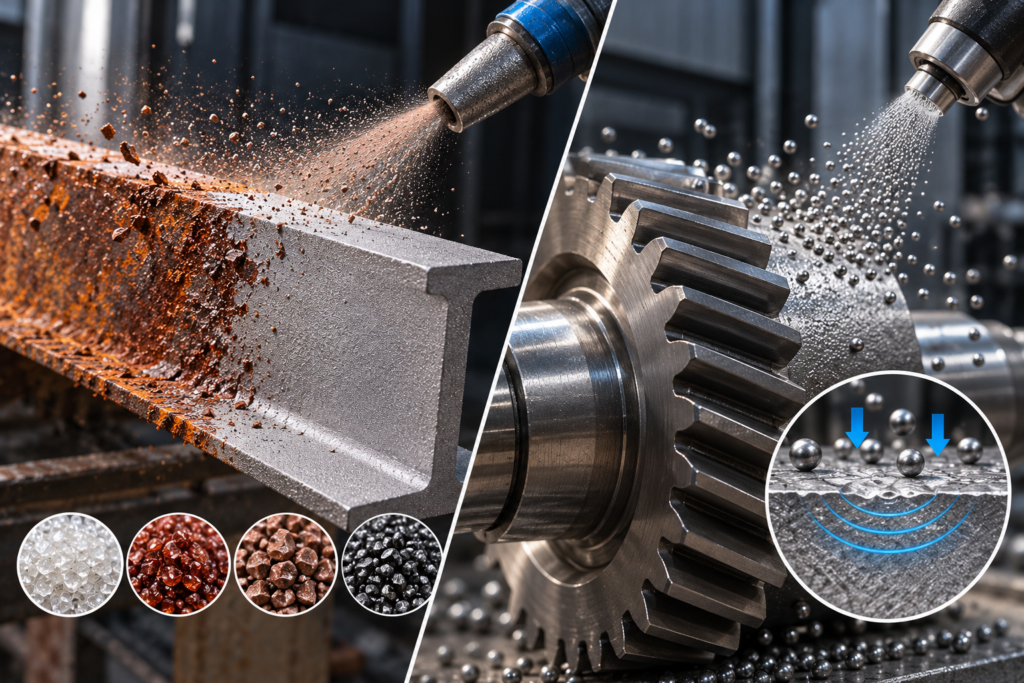
industrial surface treatment, abrasive blasting and shot peening may use similar equipment and propel particles against metal surfaces. However, these processes serve different purposes.
Abrasive blasting primarily prepares a surface by removing rust, paint, scale, and other contaminants. Shot peening, on the other hand, is designed to improve the fatigue performance of certain metal components by introducing beneficial compressive residual stress at the surface.
Choosing the wrong process can lead to poor coating preparation, unnecessary processing costs, or failure to achieve the intended mechanical properties. Understanding the difference helps manufacturers select the right method for each application.
What Is Abrasive Blasting?
Abrasive blasting is a surface preparation process that propels abrasive particles toward a workpiece using compressed air or a mechanical blasting system.
The impact of the abrasive removes unwanted material and can create a surface profile that helps protective coatings adhere properly.
Common applications include:
- Removing rust, paint, mill scale, and surface contaminants.
- Preparing steel structures before painting or coating.
- Cleaning industrial equipment and fabricated components.
- Preparing metal surfaces for subsequent finishing processes.
Different abrasive materials offer different characteristics. Glass Beads are commonly used for cleaning and producing a smoother, more uniform finish, while Garnet and Aluminium Oxide can be selected for applications requiring more aggressive cleaning or surface preparation, depending on the material and operating conditions.
The appropriate abrasive depends on the workpiece material, required surface profile, contamination level, and finishing requirements.
Read More : Abrasive Consumption: What Makes Sandblasting Use More Media?
What Is Shot Peening?
Shot peening is a controlled surface treatment process that uses repeated impacts from small spherical media to introduce compressive residual stress into the surface layer of a metal component.
Unlike conventional abrasive blasting, shot peening is not primarily intended to remove rust or prepare a surface for coating. Its main purpose is to improve resistance to fatigue cracking in components exposed to repeated or cyclic loading.
Typical applications include:
- Automotive springs, gears, and selected drivetrain components.
- Aerospace components exposed to repeated stress.
- Industrial shafts, gears, and mechanical parts.
- Metal components that require improved fatigue resistance.
Shot peening commonly uses spherical steel shot, conditioned cut wire, or other specifically qualified media. The media, impact intensity, coverage, and process parameters must be controlled to achieve the required results.
The effectiveness of shot peening depends on more than the media itself. Factors such as Almen intensity, coverage, media condition, and the component’s material properties are also important.
Abrasive Blasting vs Shot Peening: Key Differences
Although both processes use particle impact, their objectives and acceptance criteria are different.
| Comparison | Abrasive Blasting | Shot Peening |
|---|---|---|
| Primary purpose | Surface cleaning and preparation | Improve fatigue resistance |
| Main mechanism | Removes contaminants and may create a surface profile | Introduces compressive residual stress |
| Typical media | Garnet, Glass Beads, Aluminium Oxide, and other suitable abrasives | Steel shot, conditioned cut wire, and qualified peening media |
| Particle shape | Angular or spherical, depending on the application | Generally spherical or specifically conditioned |
| Main quality checks | Cleanliness, surface profile, dust, and contamination | Almen intensity, coverage, media condition, and process verification |
| Typical next step | Painting, coating, bonding, or finishing | Component assembly or further qualified processing |
| Primary success criterion | Required surface condition is achieved | Required peening intensity, coverage, and mechanical benefit are achieved |
One important distinction is that shot blasting and shot peening are not interchangeable terms. Shot blasting commonly refers to a cleaning or surface preparation process using propelled shot. Shot peening refers to a controlled treatment intended to induce beneficial compressive residual stress.
Why Similar Equipment Can Produce Different Results
Both processes may use blast wheels, compressed air, enclosures, and particle-recovery systems. However, the equipment configuration alone does not determine the treatment’s purpose.
1. Media shape changes the impact mechanism
Angular abrasive particles are effective at cutting, removing contaminants, and creating surface texture. Spherical media distribute impact differently and are commonly used in shot peening to produce controlled surface deformation.
Using an unsuitable media shape can prevent a process from achieving its intended result.
2. Process parameters must match the objective
In abrasive blasting, operators typically adjust parameters such as air pressure, nozzle distance, abrasive flow, and exposure time to meet surface preparation requirements.
Shot peening requires more specialized process control. Impact intensity, coverage, media size, media velocity, and equipment consistency must be verified against the applicable specification.
Simply increasing pressure or extending processing time does not guarantee a better result in either process.
3. The required surface condition is different
Abrasive blasting may intentionally create a roughness profile that supports coating adhesion. Shot peening produces a pattern of overlapping impact impressions while introducing compressive stress beneath the surface.
A surface that looks clean or visually uniform is not necessarily proof that either process has met its technical requirements.
4. Quality control follows different standards
For abrasive blasting, inspection may include visual cleanliness, surface profile measurement, and checks for dust or soluble salt contamination when required by the coating specification.
For shot peening, verification may include Almen strip testing, coverage assessment, media condition monitoring, and other checks required by the engineering specification.
These measurements assess different properties. Passing a surface cleanliness inspection does not demonstrate that shot peening has achieved the required intensity.
Can Abrasive Blasting Replace Shot Peening?
In general, no. Conventional abrasive blasting should not be treated as a substitute for a qualified shot peening process when the design depends on compressive residual stress and improved fatigue performance.
Abrasive blasting can clean a component and prepare it for a subsequent process, but it does not automatically produce the controlled mechanical effects required from shot peening.
Likewise, shot peening is not a replacement for abrasive blasting when a component requires a specified level of rust removal, coating removal, or surface profile.
Some industrial applications may require both processes at different stages. The sequence must be established by the relevant engineering and coating requirements because subsequent treatments can affect the resulting surface condition or residual stress.
How to Choose the Right Process
Before selecting a method, consider the following questions:
- Is the main objective cleaning or fatigue improvement? Choose abrasive blasting for surface preparation requirements and shot peening when a component requires a qualified peening treatment.
- What does the specification require? Check the required cleanliness grade, surface profile, Almen intensity, coverage, or other applicable acceptance criteria.
- What media is suitable? Consider particle shape, size, hardness, material compatibility, and the process specification.
- How will the result be verified? Establish the inspection method before processing begins.
- What happens after treatment? Determine whether the component will be coated, assembled, machined, or subjected to another surface treatment.
For abrasive blasting operations, selecting a suitable media is an important part of achieving consistent cleaning and surface preparation. PURFEQU offers abrasive media options for industrial applications, including Glass Beads, Garnet, Aluminium Oxide, Steel Shot, and Steel Grit. The right selection depends on the required surface condition and process.
For shot peening, media selection and process settings should follow the component’s engineering specification rather than being based on general abrasive blasting recommendations.
Frequently Asked Questions (FAQ)
1. What is the main difference between abrasive blasting and shot peening?
Abrasive blasting is primarily used to clean surfaces and prepare them for subsequent treatments. Shot peening is a controlled process designed to introduce compressive residual stress and improve fatigue performance in suitable metal components.
2. Can Glass Beads be used for shot peening?
Glass Beads can be used in certain specialized peening applications when the process specification permits them. However, not all glass bead blasting qualifies as shot peening. Media specifications and process controls must match the intended application.
3. Is shot blasting the same as shot peening?
No. Shot blasting generally refers to a blasting process used for cleaning or surface preparation, while shot peening is a controlled treatment intended to improve fatigue performance through compressive residual stress.
4. Which process is better for rust removal?
Abrasive blasting is generally the appropriate choice for rust removal and surface preparation. The abrasive type and operating parameters should be selected according to the substrate and required surface condition.
5. Does shot peening make every metal component stronger?
No. Shot peening can improve fatigue resistance in appropriately designed and processed components, but the outcome depends on material properties, geometry, treatment parameters, and the application. Incorrect processing may produce undesirable results.
Conclusion
Abrasive blasting and shot peening may share similar equipment, but they serve different engineering purposes. Abrasive blasting focuses on surface cleanliness and preparation, while shot peening applies controlled impacts to improve fatigue performance.
Understanding these differences helps manufacturers avoid incorrect process selection, maintain quality requirements, and control production costs.
For industrial surface preparation, choosing suitable abrasive media is an important step toward achieving consistent results. Explore PURFEQU’s abrasive media range to identify options suited to your cleaning and surface preparation requirements.