
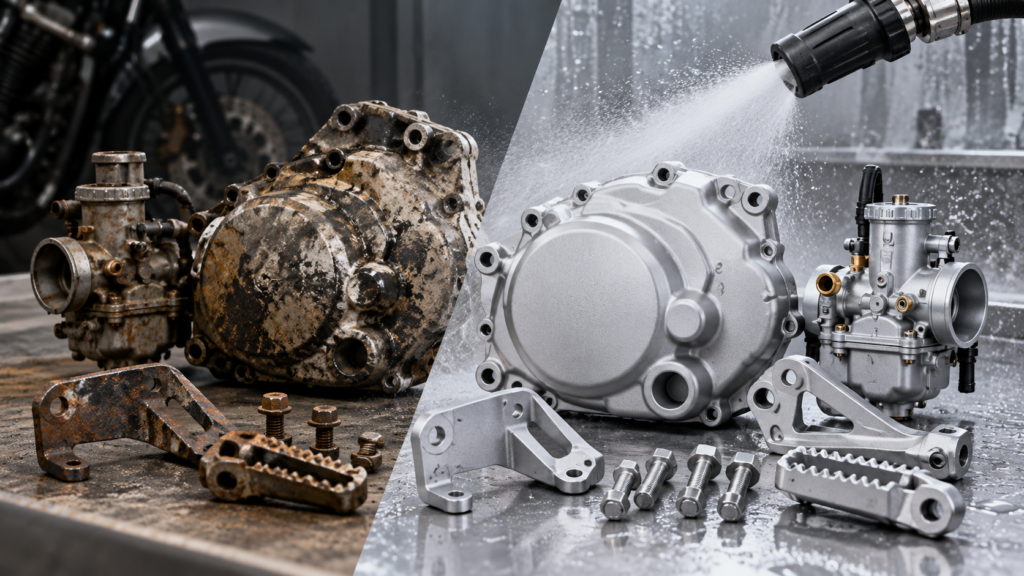
Restoring a motorcycle often requires more than removing dirt and rust. Engine cases, brackets, carburetor parts, and other components can develop oxidation, oil residue, stains, and surface contamination over time. Vapor blasting is one method that can help clean and refinish these components while producing a smooth, uniform appearance.
In this guide, we will look at how vapor blasting works for motorcycle restoration, which components are commonly treated, and how to achieve consistent results.
What Is Vapor Blasting?
Vapor blasting, also known as wet blasting, combines abrasive media, water, and compressed air to clean and finish a surface.
Unlike dry blasting, the presence of water helps suppress dust and can provide a more controlled blasting process. The abrasive media removes contaminants and oxidation while the water helps carry away loosened particles.
This makes vapor blasting particularly useful for motorcycle components where both cleaning performance and surface appearance are important.
Why Use Vapor Blasting for Motorcycle Restoration?
Motorcycle components can accumulate years of contamination. Engine parts may have oil stains, oxidation, carbon deposits, and other residues that are difficult to remove with conventional cleaning.
Vapor blasting can help restore a more consistent appearance to suitable metal components.
Some potential benefits include:
- Effective removal of surface contamination
- Reduced airborne dust compared with dry blasting
- More uniform surface appearance
- Suitable for many metal components
- Useful for restoration and refinishing projects
- Can produce a clean, satin-like finish on suitable surfaces
However, the final result depends on several factors, including the abrasive media, pressure, component material, blasting technique, and previous surface condition.
Motorcycle Parts Commonly Treated with Vapor Blasting
1. Engine Cases
Engine cases are among the most common components associated with motorcycle vapor blasting.
Aluminum engine cases can develop oxidation, stains, oil residue, and discoloration over time. Vapor blasting can help clean these surfaces and restore a more uniform appearance.
Before blasting, the component should be properly disassembled and degreased. Sensitive areas such as bearings, seals, oil passages, and internal cavities should also be protected.
2. Carburetor Parts
Carburetor components can become dirty and oxidized after years of use.
Vapor blasting may be suitable for certain external metal carburetor components, particularly when restoration requires both cleaning and a consistent surface appearance.
However, carburetors contain small passages and sensitive components. They should be completely disassembled and thoroughly cleaned after blasting to prevent abrasive or slurry residue from remaining inside.
3. Brackets and Mounting Components
Motorcycle brackets, mounts, and other metal hardware can accumulate rust, oxidation, paint residue, and surface contamination.
For suitable metal parts, vapor blasting can provide a more consistent surface before refinishing or reassembly.
This is especially useful when restoring older motorcycles where many small components have different levels of surface contamination.
4. Other Metal Components
Depending on the material and condition, vapor blasting can also be considered for components such as:
- Engine covers
- Aluminum housings
- Brake components
- Footpeg brackets
- Clamps
- Small metal hardware
- Other suitable restoration components
Always check the material and construction of a component before selecting the blasting method.
Read More : How to Choose the Right Abrasive Media for Sandblasting
Choosing the Right Abrasive Media
The abrasive media plays an important role in the final result.
Different media have different levels of hardness, particle shape, and cutting action. Therefore, choosing a media based only on price can lead to inconsistent results.
For motorcycle restoration, the desired result should be considered first.
For example:
Smooth and refined appearance
→ A finer and less aggressive media may be appropriate.
More aggressive cleaning
→ A harder abrasive may be considered depending on the material.
Surface preparation
→ Media selection should depend on the existing coating, oxidation, contamination, and desired surface profile.
This is why understanding the relationship between abrasive media and surface material is important before starting a restoration project.
Vapor Blasting Process for Motorcycle Parts
A typical restoration process can be divided into several stages.
Step 1: Disassemble the Component
Remove bearings, seals, rubber components, electrical parts, and other components that should not be exposed to blasting.
Step 2: Degrease the Surface
Oil and grease should be removed before blasting. Heavy contamination can reduce blasting efficiency and contaminate the blasting mixture.
Step 3: Protect Sensitive Areas
Mask or protect:
- Oil passages
- Bearing seats
- Threads
- Internal cavities
- Sealing surfaces
- Precision-machined areas
Step 4: Select the Abrasive Media
Choose the media based on the component material and desired finish.
Step 5: Vapor Blast the Component
Maintain consistent blasting distance, pressure, and movement. Avoid concentrating the blasting action on one area for too long.
Step 6: Rinse Thoroughly
After blasting, rinse the component carefully to remove abrasive residue and slurry.
Step 7: Inspect and Dry
Inspect the entire component, including cavities and passages. Make sure it is completely dry before reassembly.
Read More : How to Keep Abrasive Blasting Results Consistent
How to Get a Consistent Finish
One of the biggest challenges in motorcycle restoration is achieving a consistent appearance across different components.
Several factors can affect the result:
Abrasive media
Different media produce different surface characteristics.
Particle size
Finer particles and larger particles can produce different cleaning and finishing results.
Blasting pressure
Higher pressure can increase the aggressiveness of the process, but excessive pressure may produce an unwanted finish.
Blasting distance
Keeping the nozzle distance consistent helps maintain a more uniform result.
Operator technique
The speed and movement of the nozzle can significantly affect the surface.
For this reason, consistency requires more than simply placing a component inside a blasting cabinet.
Vapor Blasting vs. Traditional Cleaning
For motorcycle restoration, vapor blasting is not necessarily a replacement for every cleaning method.
Different contaminants may require different approaches.
For example:
| Cleaning Method | Typical Purpose |
|---|---|
| Degreasing | Removing oil and grease |
| Wire brushing | Light mechanical cleaning |
| Dry blasting | Aggressive surface cleaning |
| Vapor blasting | Cleaning and surface refinement |
| Polishing | Producing a brighter surface |
In many restoration projects, several cleaning methods can be used together depending on the condition of the component.
Important Considerations Before Vapor Blasting
Vapor blasting can be highly useful, but preparation is essential.
Before starting:
- Identify the component material.
- Completely disassemble sensitive parts.
- Remove oil and grease.
- Protect precision surfaces.
- Select suitable abrasive media.
- Use appropriate blasting pressure.
- Rinse the component thoroughly afterward.
- Check internal passages before reassembly.
For engine and carburetor components, thorough post-blasting cleaning is especially important because abrasive residue should not remain inside critical passages or moving areas.
Conclusion
Vapor blasting can be a valuable technique for motorcycle restoration, particularly for suitable aluminum and metal components such as engine cases, brackets, carburetor parts, and engine covers.
The quality of the final result depends on more than the blasting machine itself. Abrasive media, particle size, pressure, technique, surface condition, and post-blasting cleaning all contribute to the final appearance.
For restoration projects, selecting the right abrasive media for the material and desired finish is an important first step toward achieving consistent results.
FAQ
Can vapor blasting be used on motorcycle engine cases?
Yes. Vapor blasting is commonly considered for suitable metal engine components, particularly aluminum cases and covers. Proper disassembly and cleaning are essential before and after blasting.
Is vapor blasting suitable for carburetor parts?
It can be suitable for certain external metal carburetor components. The carburetor should be completely disassembled, and all passages must be thoroughly cleaned after blasting.
Does vapor blasting remove oxidation?
Vapor blasting can help remove surface oxidation and contamination from suitable metal components. The result depends on the abrasive media, blasting parameters, and condition of the surface.
What abrasive media should be used for motorcycle restoration?
The appropriate media depends on the component material, contamination level, and desired finish. A less aggressive media may be preferred for finishing, while harder media may be selected for more demanding surface preparation.
Does vapor blasting make motorcycle parts look new?
Vapor blasting can significantly improve the appearance of suitable components, but the final result depends on the original condition of the part, material, media, and blasting technique.